

Quick answer: The no-controls video version had a lower opt-in rate across 1,962 participants over three days, so keeping viewer controls remains the safer default—but the difference was not statistically significant and does not prove that restricted playback hurts conversion.
While reviewing the thank you page of one of our clients, we noticed that a video is being used as a key part of the pitch. Since this video is the most important sales element on the page, we’ve been trying to guide our audience to pay closer attention to it.
In this case, we hypothesized that changing the video playback experience might influence user behavior and improve the opt-in rate.
Quick takeaways
- We compared the default video player with a version that removed the control bar and prevented skipping.
- Across 1,962 participants over three days, the version without controls produced a lower opt-in rate.
- The result challenged our expectation that limiting user control would increase attention and conversions.
- For this audience, restricting control may have caused frustration or reduced trust.
Hypothesis: Removing the Control Bar Could Improve Opt-Ins
By removing the video control bar, users would no longer be able to skip or fast-forward. The idea was to create a more controlled viewing experience, ensuring the key messaging would be delivered in full. This is a common marketing tactic meant to increase attention and boost conversions.
Test Design: Control Bar Visible vs. Removed
We created two versions of the tripwire page:
- Control Group: The default version with the video player unchanged (control bar visible).
- Test Group: The same video, but with the control bar removed, users could only watch the video in sequence without skipping ahead.


We recommend testing your experiment before launching it; and here’s how PostHog suggests doing it; its experiment metrics guide can help you choose what to measure.
Results: Removing Controls Lowered Opt-In Rate
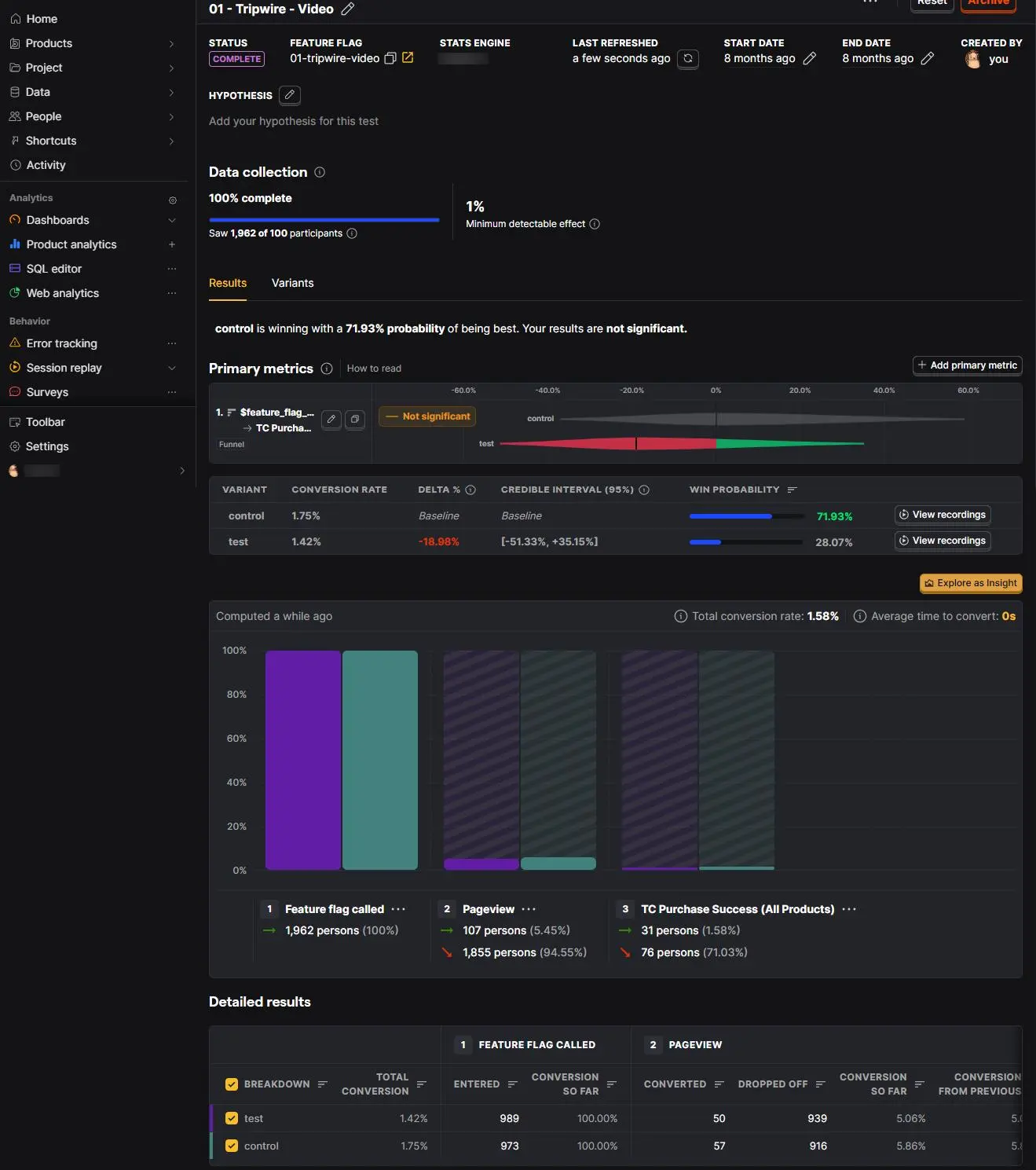
The test ran for three days, with a total of 1,962 participants across both versions.
The outcome was clear: the test group had a lower opt-in rate compared to the control. For context on how PostHog interprets experiment probabilities, see its Bayesian statistics guide.

What We Learned: Audience Control Affects Trust
This result was surprising to us. In our industry, the tactic we used (limiting user control) is typically seen as a conversion booster. It has consistently worked well in many other cases that we experience, so we expected it to perform the same way here. But in this instance, it didn’t.
The key insight is that not all audiences respond well to aggressive marketing tactics. In fact, removing the control bar may have created frustration or reduced trust, especially if users felt manipulated or forced to consume content on someone else’s terms. For accessibility guidance on keeping moving content controllable, see the W3C’s Pause, Stop, Hide guidance.
This test reminded us that understanding the audience comes first. Nielsen Norman Group’s video usability guidance also discusses user control. Even subtle UX decisions can have a big impact on behavior, and what works for one group may harm performance for another. For another video-focused case study, see our Video Length A/B Test.
Read our step-by-step guides to see exactly how we run experiments on WordPress, Shopify, and ClickFunnels. For a broader check on whether experiment data can be trusted, see our PostHog Audit.
Frequently asked questions
What did the video-control test change?
The control used the existing video player with its control bar visible. The variation removed the bar so viewers could not skip or fast-forward, while the rest of the tripwire page and video remained the same.
What happened when viewers could no longer skip?
Across 1,962 participants over three days, the no-controls variation produced a lower opt-in rate than the control. The result image describes the difference as not statistically significant, so it is evidence against the expected benefit rather than proof of a universal conversion loss.
Why might removing playback controls reduce conversion?
Viewers may feel trapped, frustrated, or less trusting when they cannot navigate content on their own terms. Restricted playback can also make it harder to revisit a claim, accommodate interruptions, or use the video with accessibility needs; these are plausible mechanisms, not effects measured separately in this test.
Can forcing viewers to watch the full sequence ever help?
It can ensure that a CTA or claim is not reached before its context, but that benefit must outweigh the loss of autonomy and convenience. Measure the final business outcome rather than assuming that longer forced exposure means better attention or persuasion.
Which video controls should normally remain available?
A usable player should support play and pause, volume, seeking, captions when speech is present, keyboard operation, and an accessible full-screen experience. Playback speed can also help viewers match the presentation to their needs, particularly for longer educational material.
How should a cleaner playback-control test be designed?
Keep the video file, player styling, page copy, CTA timing, and traffic source unchanged, then alter only the specific control being evaluated. Testing “seek disabled” separately from hiding the entire control bar produces a more actionable result.
What should be measured besides the opt-in rate?
Track video starts, progress, seeking behavior, completion, CTA exposure, exits, playback errors, and the final purchase or opt-in. Break diagnostics down by device and connection quality because a restrictive player may be especially costly on mobile or unreliable networks.
What is the practical default for video controls?
Start by preserving viewer control and accessible playback. Restrict a feature only when there is a clear user or business reason, test that restriction directly, and reverse it when the evidence does not show a compensating benefit.