
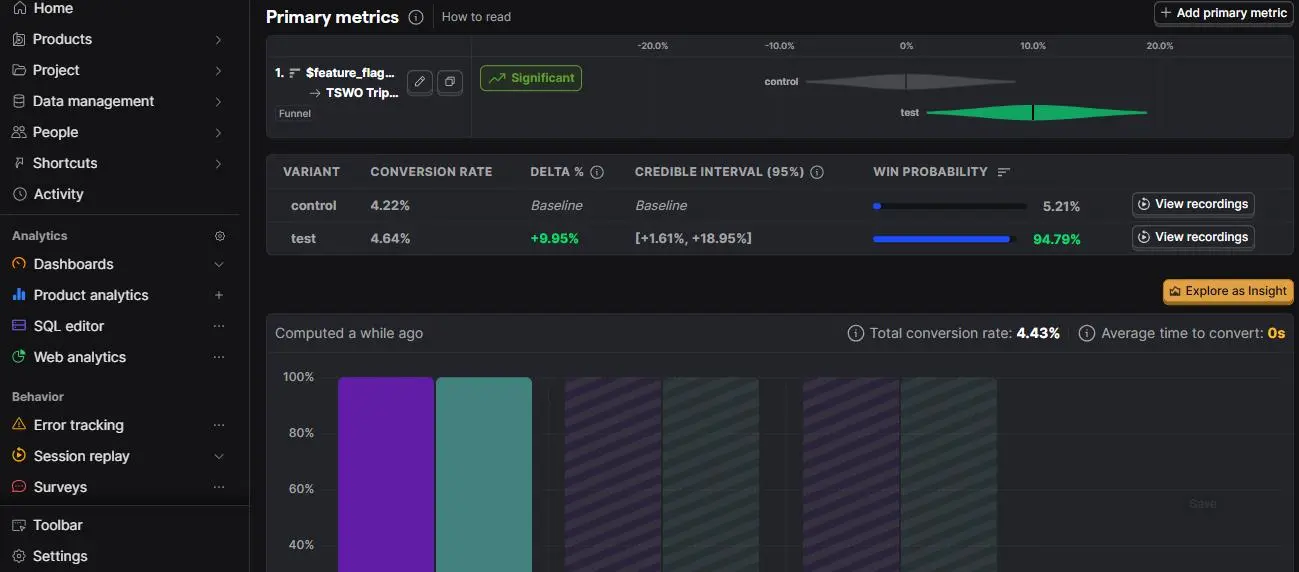
Quick answer: Adding a live Provely activity widget reached a 4.64% conversion rate and a 94.79% probability of beating the original page across 25,544 users, but the two-day result should be retested—and any deployment should use genuine, privacy-safe notifications.
In this test, we wanted to go further and add an external element to the thank-you page of one of our client’s websites.
Quick takeaways
- We compared the original thank-you page with a version that added the Provely widget to show live user activity.
- Over two days, 25,544 users participated, and the variation had a 94.79% probability of outperforming the control.
- The test suggests live user activity can strengthen trust and encourage conversions.
- This was a two-day test on a thank-you page selling access to a private community.
The page already included social proof in the form of testimonials. For broader experiment-design guidance, see PostHog’s A/B testing best practices. However, based on our analysis and prediction of the client’s audience and given that social proof has consistently improved opt-in rates on other projects we’ve worked on, we hypothesized that introducing another form of social proof could boost conversions even further.
Since the page is selling access to a private community, we believed it would be helpful for potential buyers to see that others were actively joining and happy with their purchase.
Hypothesis
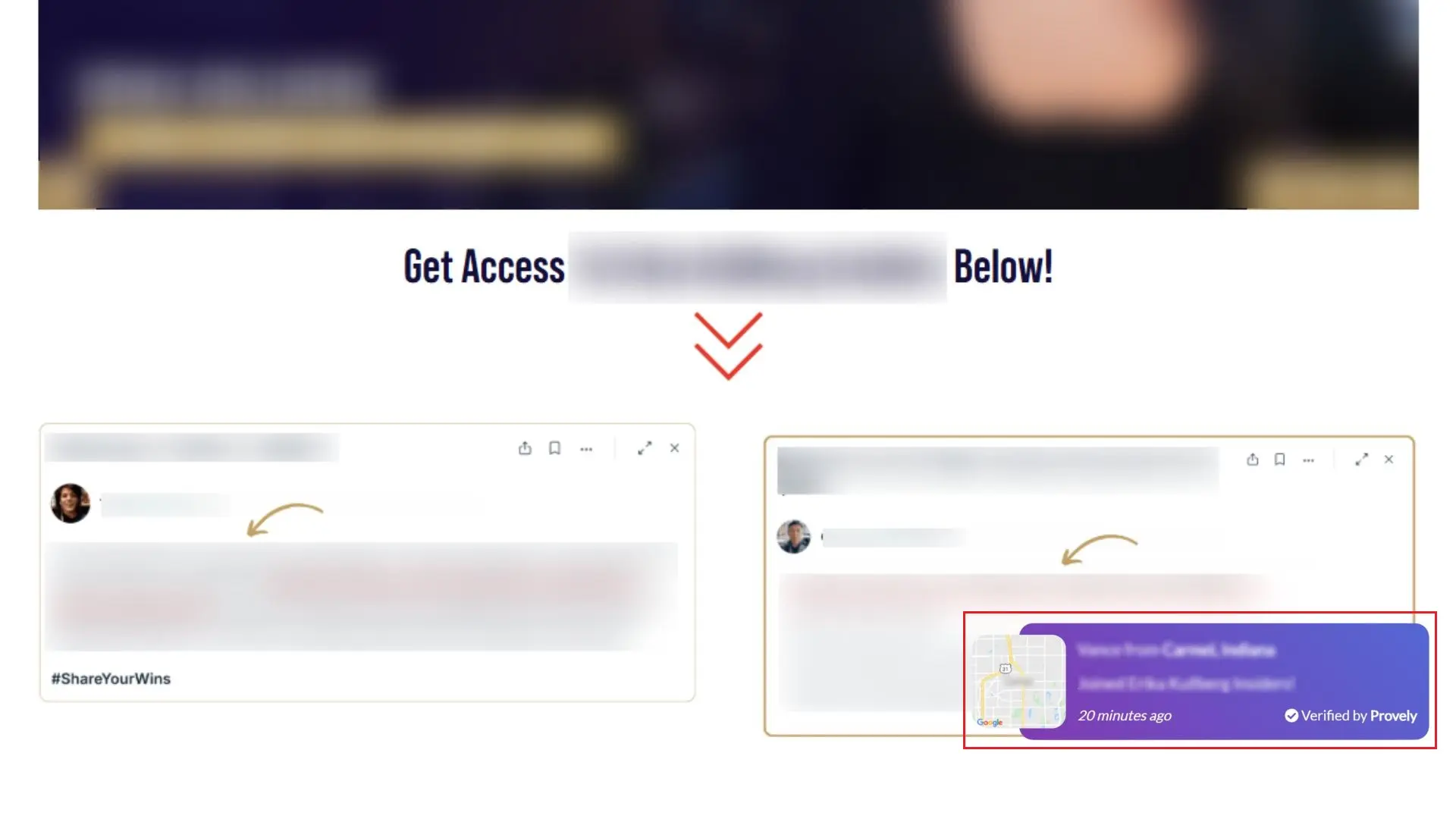
We hypothesized that adding a live widget showing real-time user activity (e.g., who’s joining the community, where they’re from, and when they joined) would increase trust and encourage more conversions. To test this, we used the Provely widget and placed it at the bottom right corner of the page.
Test Design
- Control Page: Original version with no additional social proof
- Test Page: Original version plus the Provely widget showing live social proof
Results
The experiment ran from Wednesday, October 23, 2024, for two days. For statistical background on how hypothesis tests are interpreted, see NIST’s guide to statistical tests.
A total of 25,544 users participated in the test.
See PostHog’s experiment metrics guide for guidance on measuring experiment outcomes. For a practical guide to choosing a primary A/B-testing metric, see our A/B Testing Metrics guide.The results were significant: the test variation had a 94.79% probability of outperforming the control. For a deeper look at whether an A/B test result can be trusted, see our Experimentation System Audit.

What We Learned
This test confirmed that live user activity widgets can meaningfully boost conversions by building trust. Compare this result with our Testimonial A/B Test.
It reminded us that asking people to take action, like making a purchase, requires first earning their trust. Without trust, there’s no communication. And without communication, there’s no market.
In this case, we didn’t rely solely on testimonials. We also used a dynamic widget to show users that real people were actively purchasing and benefiting from the product. This reinforced credibility and encouraged hesitant visitors to move forward.
Ultimately, this test highlighted that building trust is just as important as the product itself and we should always look for creative ways to strengthen it.
Read this PostHog article to get a clear understanding of how to run A/B/n tests. For a broader overview of experiment setup and analysis, see PostHog’s Experiments documentation.
Then, explore the guides below to learn how to set up A/B tests on specific platforms: [ClickFunnels, Shopify]. For WordPress, see our guide to running a PostHog A/B test.
Frequently asked questions
What did the live-social-proof experiment change?
The control kept the original thank-you page and its existing testimonials. The variation added a Provely widget in the bottom-right corner showing recent community activity, so the widget was the intended difference between the two experiences.
What result did the activity widget produce?
Across 25,544 participants in two days, the variation reached a 4.64% conversion rate and a 94.79% probability of outperforming the control. That is strong directional evidence for this page, although the short duration leaves weekday, novelty, and longer-term effects less certain.
How can live activity notifications influence buyers?
They can reduce uncertainty by showing that other people are actively taking the same step and that the community is not dormant. The conversion result is consistent with that trust mechanism, but the experiment measured behavior rather than asking visitors whether trust caused their decision.
Are live purchase or signup notifications ethical?
Only when the activity is genuine, timely, and displayed with appropriate privacy protection. Do not fabricate names, locations, counts, or recency; avoid revealing identifiable customer information without permission, and make the notification dismissible when it could distract or obstruct the page.
How are live notifications different from testimonials?
Testimonials provide depth: they can explain the problem, experience, and outcome behind a customer’s endorsement. Activity notifications provide immediacy and participation signals. They can complement one another, but stacking too much proof can feel manipulative or crowd out the offer itself.
Where and how often should a social-proof widget appear?
Place it where it does not cover the CTA, navigation, consent controls, or important mobile content. Limit frequency, leave enough time to read each message, and give visitors control to dismiss it; the goal is credible reassurance, not a continuous interruption.
Was a two-day test long enough?
The large sample produced a favorable probability quickly, but sample size does not replace calendar coverage. A planned test should usually span the traffic patterns that matter to the business and continue long enough to reveal novelty effects, technical problems, and downstream customer quality.
What should be monitored besides the immediate conversion?
Track purchases or accepted offers alongside refunds, cancellations, notification dismissals, support or privacy complaints, page speed, and mobile errors. Those guardrails show whether the widget creates durable confidence or merely a short-lived interaction lift at the cost of trust or usability.